
ORGANIZATIONAL DIAGNOSIS
Once You Know Where You Stand, You Know Where to Change
ReNova’s organizational diagnosis measures Skill, OS, and Infrastructure, each with a different method. Rather than asking "what is lacking," we use numbers and facts to reveal "where execution has stalled."
Three Diagnoses
-
01
Skill Diagnosis
We define the Skill required for each position across 7 areas and 52 items. Simply choose from the behavioral options to see where you stand.
-
02
OS Diagnosis
Through a one-hour interview, we assess the developmental stage of the foundation of judgment (OS). We provide two types of reports: one for the individual and one for the organization.
-
03
Infrastructure Diagnosis
A third party draws out candid views from the frontline, and reveals the defects in the organizational foundation arising "between people," and the business losses they cause.
01 SKILL
We define the Skills required for each position and measure where you stand.
Skill Diagnosis by Position
Required Skills Differ by Tier
ReNova defines the necessary Skills for each of six tiers.
| Tier | Required Skills |
|---|---|
| Tier 1-1 New Hires / Rookies |
|
| Tier 1-2 Team Members / General Staff |
|
| Tier 2-1 Leaders |
|
| Tier 2-2 Managers |
|
| Tier 3-1 Business Heads |
|
| Tier 3-2 CxOs / Board Members |
|
Define the Skills Required for the Job Across 7 Areas and 52 Items
| Area | Number of Items | Evaluation Scope |
|---|---|---|
| 1. General-Purpose Portable Skills | 8 | Basic productivity and logical thinking |
| 2. Leadership & Management | 14 | Building the interpersonal relationships and systems that move individuals and organizations |
| 3. Management Strategy | 10 | Allocating resources from a company-wide perspective and establishing competitive advantage |
| 4. Marketing | 7 | From identifying market opportunities to delivering customer value |
| 5. Accounting | 6 | Understanding the causal relationship between financial figures and business activities |
| 6. Finance | 5 | Cash flow management and investment decision-making |
| 7. Technology & Digital | 2 | The ability to use IT and data as management resources |
| Total | 52 |
※For comprehensive coverage of the areas, we referred to external frameworks, and rebuilt them on ReNova’s own "behavioral facts" basis.
Simply Choose From the Behavioral Options to See Where You Stand
Task and Time Management
In situations where you manage multiple tasks and deadlines, choose the approach closest to how you have handled several recent assignments.
-
Cannot sort out deadlines and priorities, and is prone to omissions and delays
-
Checks the deadlines and priorities of their own tasks and reports progress
-
Judges the priority of multiple tasks and completes them as planned
-
Even when unexpected issues arise, checks the impact on their own and others’ tasks and adjusts priorities
-
Understands the team’s overall workload, deadlines, and assignments, and adjusts before delays or imbalances arise
-
For important cross-departmental tasks, coordinates resource allocation, deadlines, and the order of decision-making
-
Designs the organization’s task management and prioritization systems, creating a state where time is spent on key issues
-
1
Questions by "Situation"
We ask about the 7 areas and 52 items in the context of work situations
-
2
Based on Your Recent Assignments
Select what "consistently applies"
-
3
Select All That Apply
Even basic levels are included
※Screens are for illustration only. The number and content of questions vary by the respondent’s position.
See at a Glance Whether You Have Reached the Expected Skill Level
For each of the 7 areas, we compare your current level with the expected level. For each item, we show the "current state" and the "next area for growth," so you know what to tackle first.
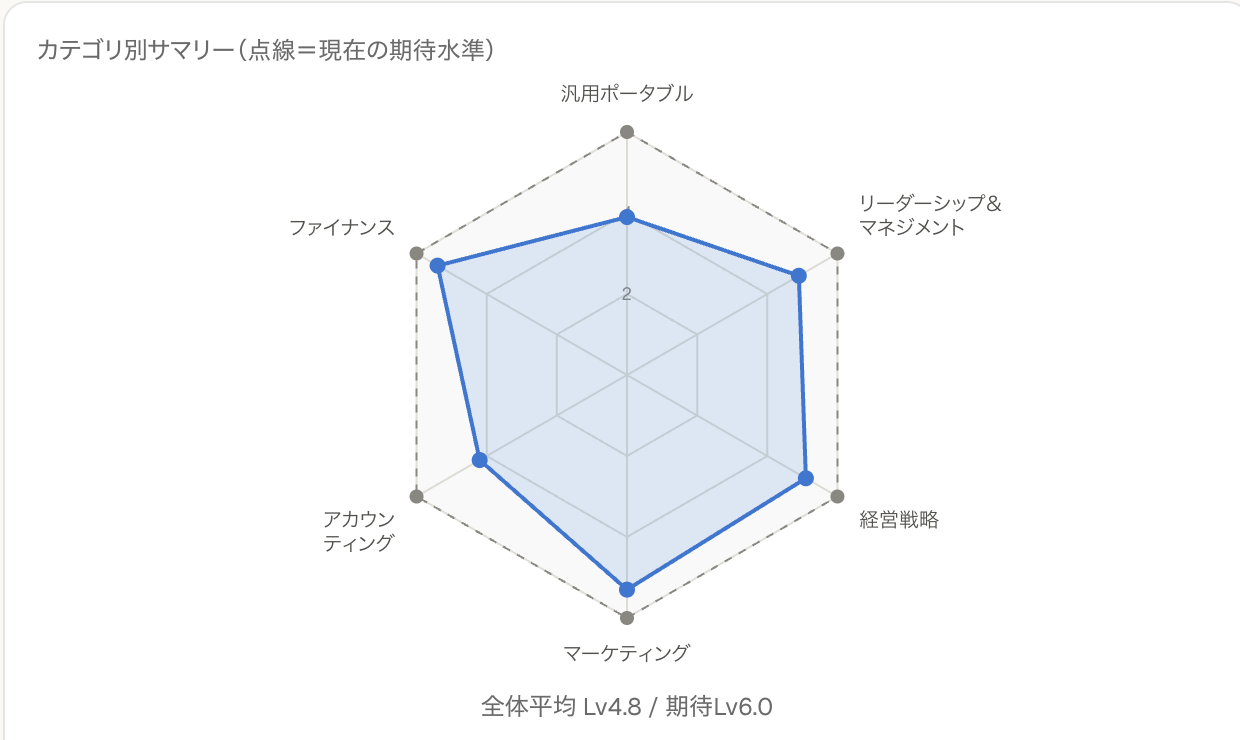
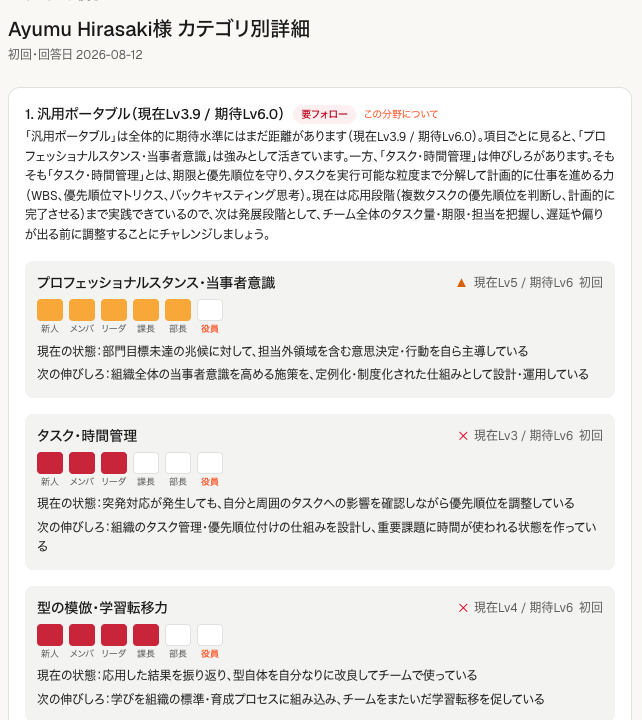
※The content shown is a sample.
02 OS
We assess the "developmental stage" of the foundation of judgment through interviews.
OS Has Developmental Stages
Based on adult development theory, ReNova understands the foundation of a person’s judgment (OS) in five stages. In adults’ working lives, the stages that mainly come into question are Stage 3 through Stage 5.
| Stage | Name | Overview | Share |
|---|---|---|---|
| Stage 5 | Self-Transforming Mind (Mutual Development) | Can relativize even one’s own value system and integrate it with different systems. Flexibly takes in others’ opinions and can engage in constructive discussion toward the purpose at hand | Less than 1% |
| Stage 4 | Self-Authoring Mind (Autonomy and Co-creation) | The self is constructed through one’s own value system. Having clear standards of value, a person can make judgments while respecting others. | 20% |
| Stage 3 | Socialized Mind (Dependent on Others) | The self is constructed by the expectations of others. A person has the perspective of others but follows the opinions of the organization and those around them, lacking initiative. | 70% |
| Stage 2 | Self-Interested Stage (Instrumental Mind) | One’s own desires and interests become the standard for judgment. A person sees things only from their own perspective and treats others like tools. | 10% |
| Stage 1 | Concrete Thinking | Grasps things through the concrete matters right in front of them. |
※Based on adult development theory. The percentages are the approximate distribution across all adults.
A Higher Stage Does Not Mean a Better Performer
A stage indicates "the range of complexity a person can handle," which is distinct from job results or level of ability. What matters is whether the complexity of the role entrusted to a person is in balance with the framework of that person’s judgment.
Looking Through "16 Levels" That Divide Each Stage into Five
Five stages alone are too coarse to capture day-to-day change, so we divide the space between stages into five. Levels are written like 4.2. The digits after the decimal point show how much of the next stage’s way of seeing is mixing in. Stages cannot be skipped.
- 2
- 2.2
- 2.4
- 2.6
- 2.8
- 3
- 3.2
- 3.4
- 3.6
- 3.8
- 4
- 4.2
- 4.4
- 4.6
- 4.8
- 5
View the List of 16 Levels
| Stage | Notation | Stage Name | Position | Expected Roles |
|---|---|---|---|---|
| S5 | 5 | Self-Transforming and Mutually Transforming Leaders | At Stage 5 | Self-Transforming Leader |
| 4.8 | System Leader Who Embodies Transformation | Transition to Stage 5 | Enterprise Leader | |
| 4.6 | System Leader Who Prioritizes Transformation | Transition to Stage 5 | System Leader | |
| 4.4 | Transformation Leader Who Relativizes Their Own Standards | Transition Zone | Transformation Leader | |
| 4.2 | Executive Who Recognizes the Limits of Their Own Standards | Stage 4→5 | Department Head / Business Head | |
| S4 | 4 | Autonomous Manager | At Stage 4 | Autonomous Manager / Business Head |
| 3.8 | Manager Whose Own Standards Are Stable | Transition to Stage 4 | Manager | |
| 3.6 | Team Leader Beginning to Use Their Own Standards | Transition to Stage 4 | Team Leader | |
| 3.4 | Leader Candidate Struggling with Differences | Transition Zone | Leader Candidate / Mid-Career Team Member | |
| 3.2 | Team Member in Whom Autonomy Is Emerging | Stage 3→4 | Team Member Becoming Autonomous | |
| S3 | 3 | Team Member Who Carries Out Expectations | At Stage 3 | New Hire to Mid-Career Team Member |
| 2.8 | Team Member with Growing Relational Identification | Transition to Stage 3 | Team Member | |
| 2.6 | Team Member Shifting Toward Prioritizing Expectations | Transition to Stage 3 | Team Member | |
| 2.4 | Team Member Torn Between Self-Interest and Others’ Expectations | Stage 2→3 | Junior to Mid-Career Team Member | |
| 2.2 | Performer Beginning to Notice Others’ Reactions | Stage 2→3 | Junior Team Member | |
| S2 | 2 | Performer Driven by Self-Interest and Desires | At Stage 2 | Early-Stage Team Member / Individual Contributor |
※2.2 to 4.8: positions between stages shown in 0.2 increments (the larger the decimal, the closer to the next stage) \
Identify the Center of Gravity of Meaning-Making in a One-Hour Interview
The diagnosis is conducted through a one-hour interview with each person. From what we hear, we assess where the foundation of their judgment (the OS) stands now.
-
STEP 1
Choose Themes
At the start, we ask about your current role and the work you are in charge of. You then choose at least three themes yourself from the following and talk about them: success / change / power / limits / alienation / irritation / what matters / sharing / beliefs and convictions / risk.
-
STEP 2
Listen for Meaning-Making
We listen for "the standards by which each statement is given meaning and judged." Our clues for the assessment are: identification / objectification / how others are perceived / desires / the source of desires / how experiences are given meaning.
-
STEP 3
Determine the Center of Gravity
Across multiple episodes, we identify the center of gravity of the person’s meaning-making that appears consistently.
We Never Decide a Developmental Stage from a Single Word or Episode
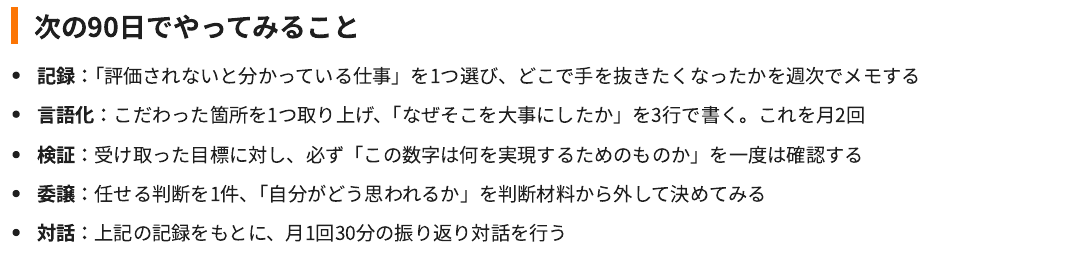
We Return the Measurement Results in Two Types of Reports
-
For the Individual | Feedback Report
Where You Stand Now and How to Develop from Here
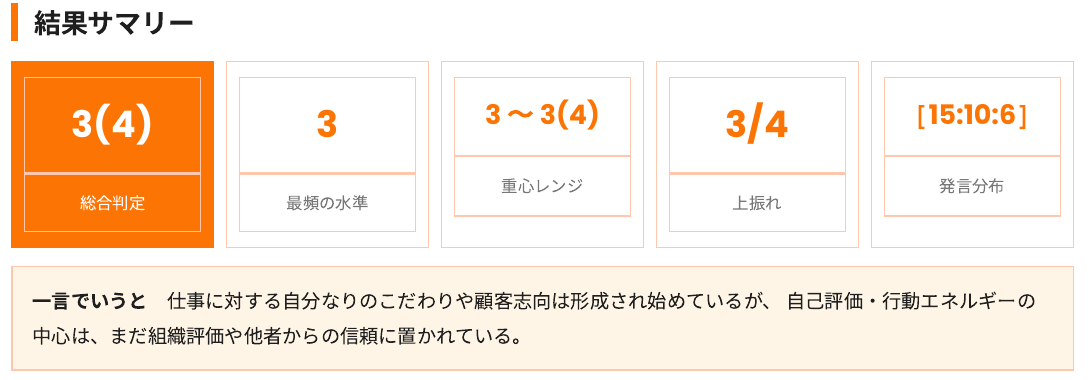
-
For the Organization | Findings Report
Basis for the Assessment and Suggestions for Development and Engagement
※The content shown is a sample. Actual reports are created for each participant.
Understand Each Person’s "Current Position" and "How to Develop Them"
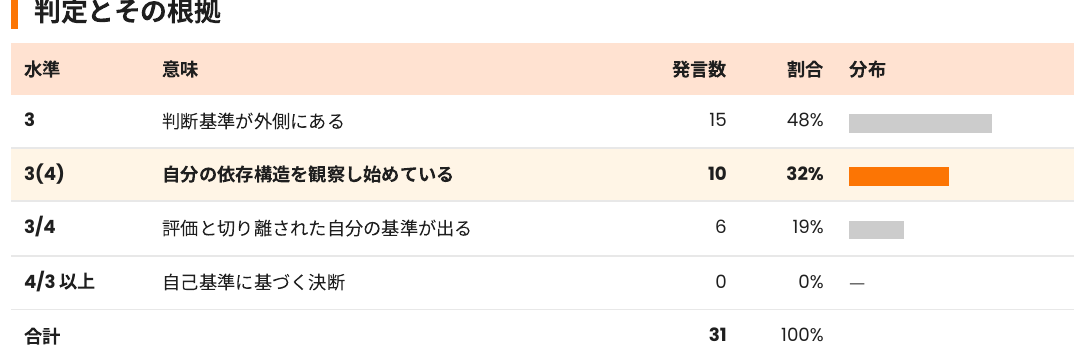
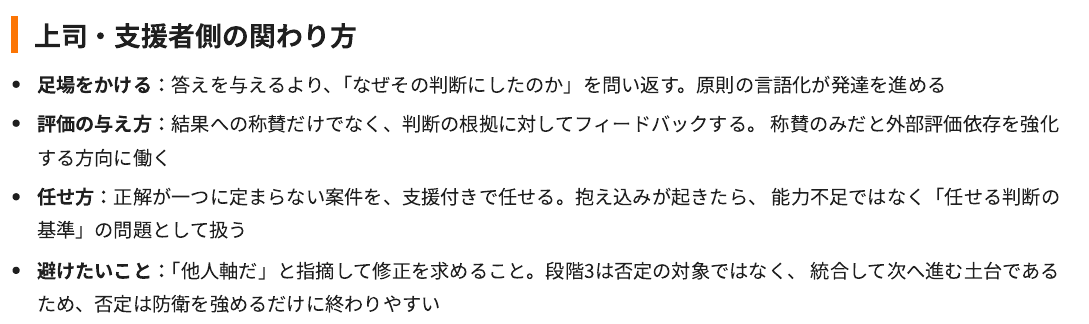
We classify interview statements by level and deliver, in a "diagnosis report," everything from the basis for the assessment to how supervisors should engage.
-
01
See Where You Stand Now
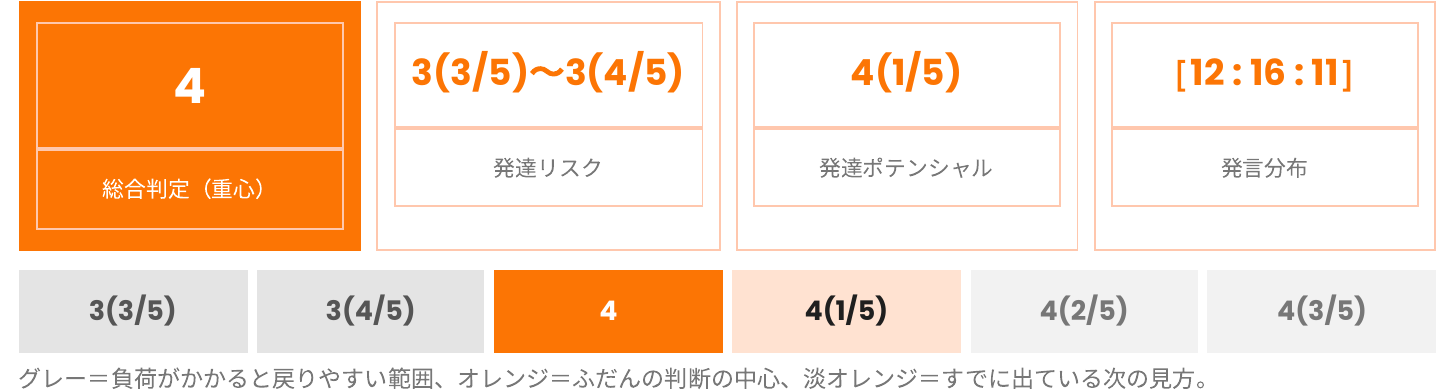
In addition to the overall assessment (center of gravity), see at a glance the "developmental risk" a person tends to fall back into under pressure and the "developmental potential" that has already begun to sprout.
-
02
See the Basis for the Assessment
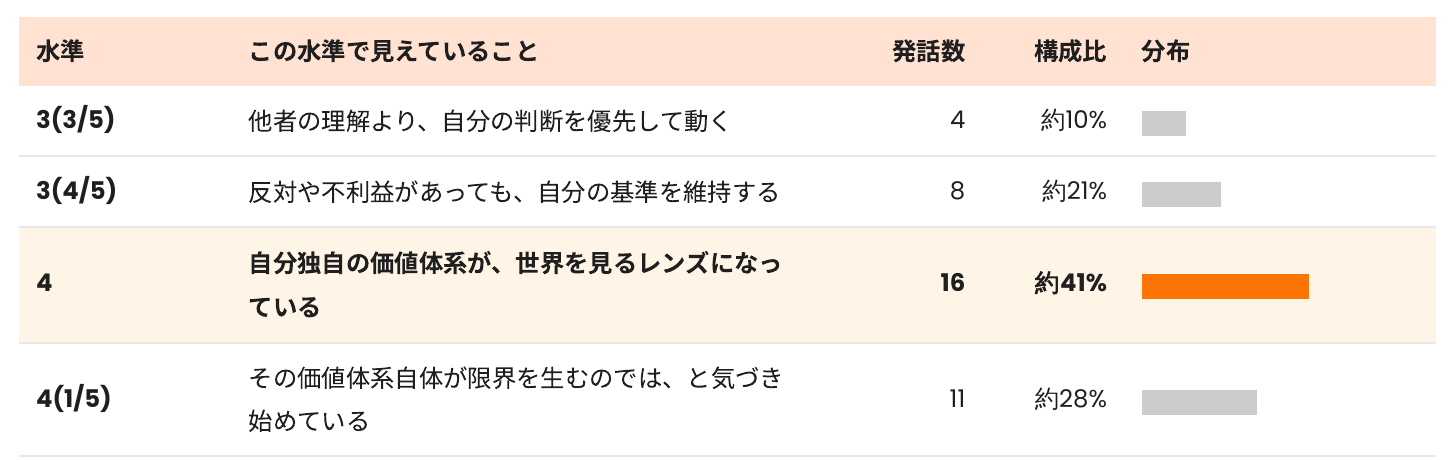
Statements are classified by level and presented with the number of statements and their proportions. Actual remarks are quoted to explain "why this assessment was made."
-
03
See Strengths and Room to Grow
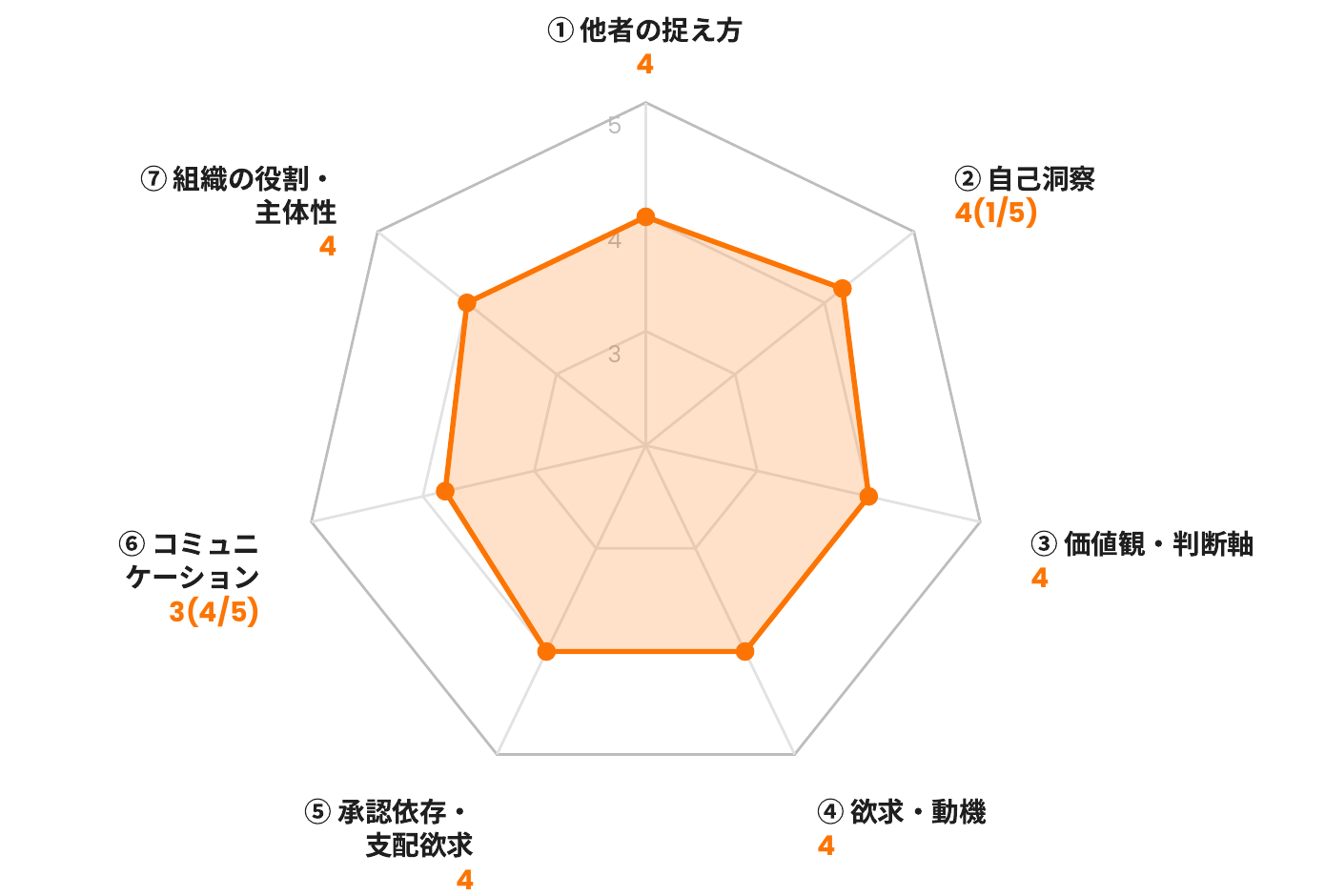
From seven perspectives, including self-insight and communication, we visualize the areas that are ahead and the areas where challenges remain.
-
04
See How Supervisors Should Engage
We present, in a form you can use starting tomorrow, examples of "questions" that promote development, ways of delegating that lead to growth, and feedback to avoid and feedback we recommend.
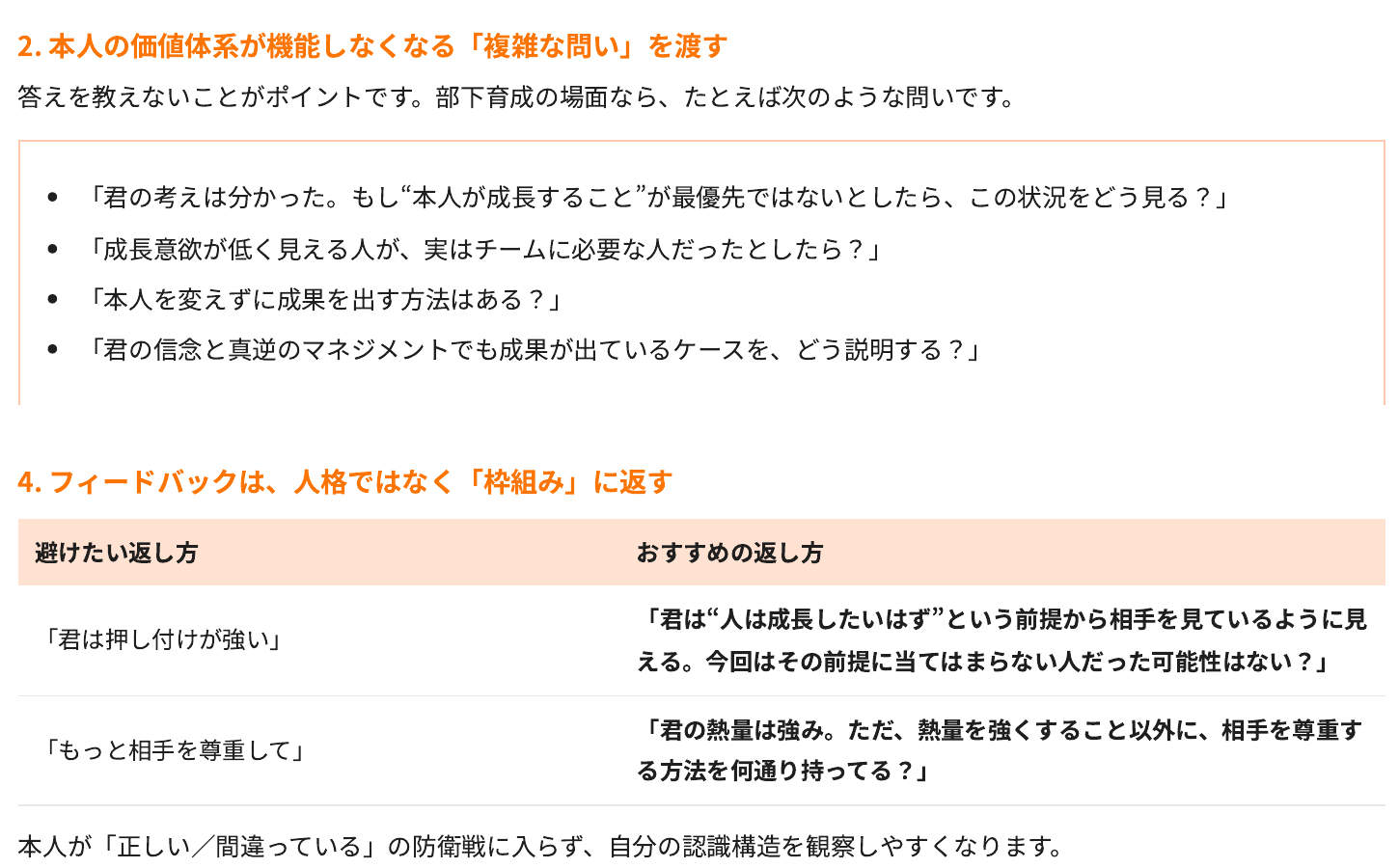
※This report is not an evaluation of personality, ability, or results, but an estimate of the structure of meaning-making. It is not intended to be used as direct grounds for HR evaluations or compensation.
03 INFRASTRUCTURE
A third party reveals the losses occurring "between people."
The Question Is Not "Employee Satisfaction" but "Losses in Organizational Infrastructure"
Critical problems arise not from individual ability, but "between people."
Goal
Skill
✕
Circulation Stops
OS
Infrastructure (Between People)
- × Ambiguity of Authority
- × Distrust of Evaluation
- × Unwritten Rules
-
01
Invisible to Management
The real friction on the frontline lies in the blind spot of top management and cannot be seen.
-
02
Why It Cannot Be Seen
Because the more critical the problem, the more it arises not from a lack of individual ability but "between people."
-
03
What ReNova Reveals
As a third party, we draw out candid views from the frontline and reveal the defects in the organizational foundation that has become a black box, along with the business losses they create.
Shedding Light on the True State of Management and the Organization: The 3 Steps of Organizational Diagnosis
Superficial surveys are meaningless. Only through the intervention of a third party can the structural issues hidden between people be extracted.
-
STEP 1
Selecting Participants
We select the frontline key people and executive-level leaders who bear the most friction in the organization, or who create it.
Recommended Participants
Middle managers who coordinate between departments
Heads of departments with continuing turnover or transfers, and their team members
Central figures in groups where dissatisfaction with evaluation and authority is concentrated
Top performers and long-serving employees trusted by the frontline
Executives who were recently promoted or joined mid-career
-
STEP 2
One-on-One Interviews (About 60 Minutes)
An outside professional steps in, in person as a rule, and draws out candid views and facts, free of deference, that could never be voiced internally.
How the Interviews Are Conducted
Held one person at a time, in person
No internal attendees present
Handled in a way that does not identify who said what
We ask about "facts that happened," not "impressions"
-
STEP 3
Structuring and Defining Issues
We do not let candid views end as complaints. We organize "what is happening between people," define it as an organizational infrastructure issue, and link it to management-level losses.
Output
Friction structure map (between whom the problem lies)
List of organizational infrastructure issues and their priorities
Estimated management losses by issue
A Reorganization Roadmap That Restores the Organization’s Ability to Execute
Based on the measurement results, we draft a plan that starts with the improvements that have the greatest business impact and are the easiest to achieve.
Feasibility Low → High
-
Quick Wins
Establish operating rules for 1on1s
Unify information-sharing rules
-
① Start First
Revise authority rules (approval authority)
Redesign meeting structures and approval routes
Articulate evaluation criteria
-
Defer
High effort relative to impact
-
② Plan, Then Start
Rebuild the evaluation system
Review the grade and compensation structure
Redesign the development framework
Business Impact Low → High
-
0–3 Months
Top-Priority Fixes
Fix the mechanisms that deliver results quickly first, such as authority rules and meeting structures
-
3–6 Months
Rebuilding the Systems
Rebuild the systems that take time to design, such as evaluation and grades
-
6 Months and Beyond
Sustained Adoption and Re-measurement
Re-diagnose to measure changes in friction and losses, then decide the next improvements
We Don’t Fix Everything: We Allocate Investment Starting Where Losses Are Largest and Results Come Fastest
※Actions and their placement are examples. The actual plan is decided based on the audit results.
Why Not Start by Measuring Where Execution Is Stalling?
Which of Skill, OS, and Infrastructure to measure first differs from one organization to another. We’ll hear about the current state of your organization and design the diagnosis you need.