
Evolving the OS of People and Organizations to Create More Companies That Win Globally
We don’t stop at training or system design. Based on our own logic, we change people’s behavior and organizational decision-making in a repeatable way, and turn that change into business results.
Organizational Transformation Partner
Toward an Organization That Can Fully Execute Its Management Strategy
From an organization where only business leaders think and the frontline waits for instructions, to one where executives, managers, and the frontline think, decide, and act on their own.
ReNova is an organizational transformation partner that changes not only people’s capabilities, but also the thinking that stops action and the organizational mechanisms that support it.
Organizational Issues
Is This Happening in Your Organization?
We start not with "causes," but with what is happening right in front of you.
-
01
Decision-Making Is Concentrated in the Hands of the Business Leader
- Every important matter becomes the president’s decision
- Work that was delegated gets taken back halfway through
- Executives look to the president for "the answer," asking, "What do you think?"
-
02
Executives and Next-Generation Management Talent Aren’t Being Developed
- They chase only their own department’s numbers and lack a company-wide or management perspective
- Executives don’t voice proposals, dissent, or opinions in executive meetings
- We can’t find or develop people to whom we can entrust the next generation of management
-
03
Managers and the Frontline Don’t Act on Their Own
- They don’t move until their supervisors instruct them, and no proactive action emerges
- Managers can’t let go of their own hands-on work
- Even when problems are noticed, they never get as far as a proposal, so they remain unaddressed
-
04
Behavior Doesn’t Change Even After Training
- Motivation is high right after training, but people revert within a few weeks
- Satisfaction is high, but people stop at being satisfied, and it doesn’t lead to behavior change or show up in business results
- What was learned isn’t used on the frontline, and a few months later it is hardly remembered
-
05
Organizations Don’t Change Even After Establishing Systems and MVV
- MVV hasn’t taken root on the frontline, and sometimes even middle managers don’t remember it
- Even after building an evaluation system, communication stays focused on short-term numerical progress
- Department heads and managers on the frontline understand the HR system and use it as a feedback tool
Why Do These Situations Persist Even After Taking Action?
There Is a Wall Between "Knowing" and "Doing"
For example,
I know it’s better to delegate to my team members. But I fear failure, so I end up stepping in.
I know it’s better to discuss things candidly. But I don’t want to be disliked, so I can’t say what I think.
I know I need to take on challenges. But I fear how I’ll be evaluated if I fail, so I choose the safe option.
Accelerator
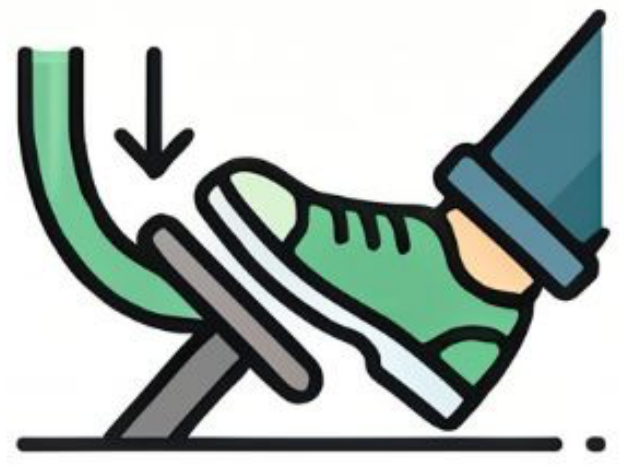
What you know you should do
Brake
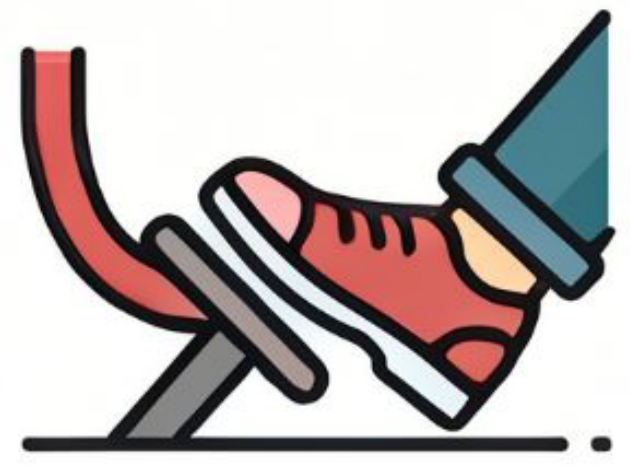
The behavior that stops it
Organizational problems come in two kinds:
"problems where people can’t act because they don’t know how," and "problems where people can’t act even though they know how."
The Four Factors Proposed by ReNova (Goal, Skill, OS, Infrastructure)
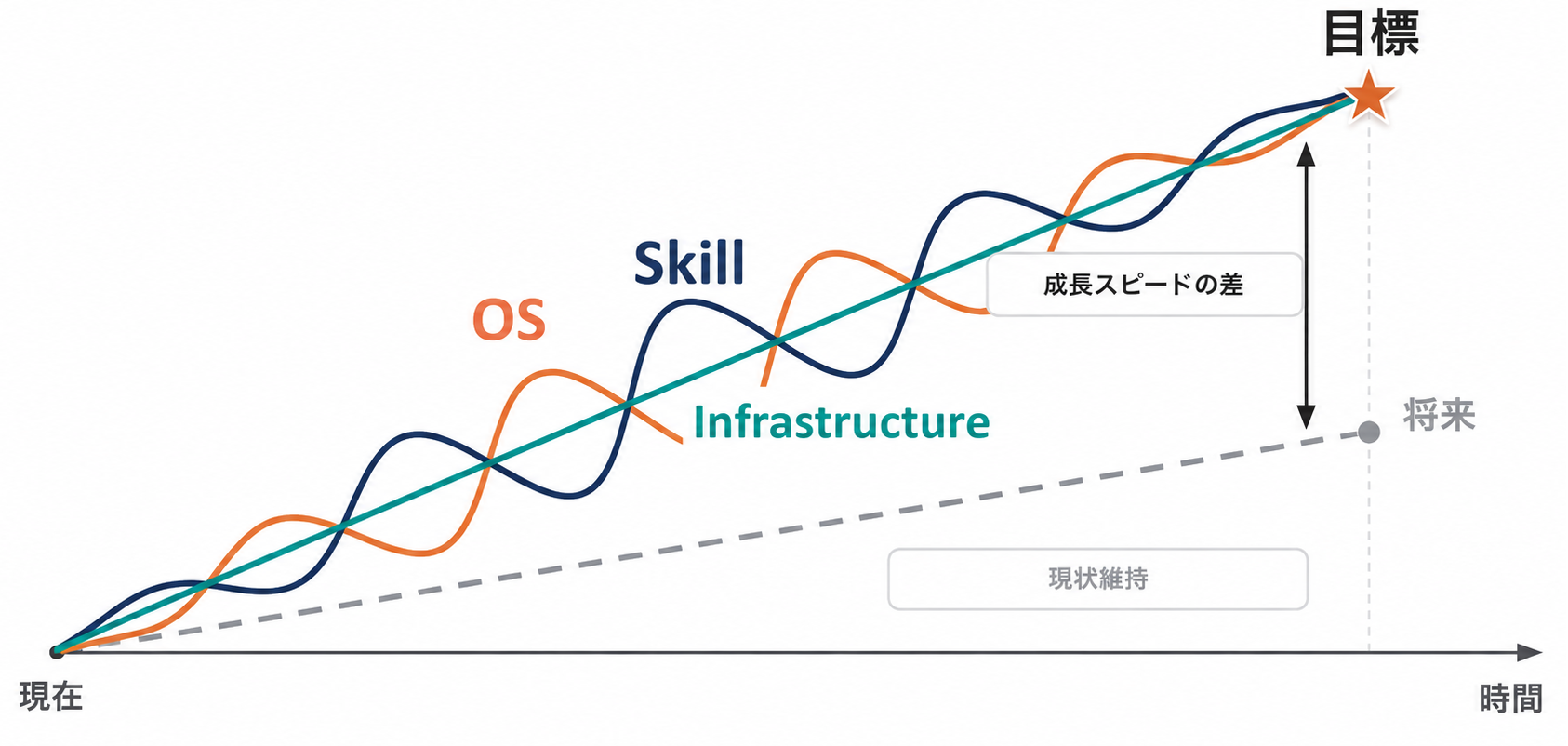
Both personal and organizational transformation depend on managing these four elements well.
Read More →| Goal | Skill | OS | Infrastructure | |
|---|---|---|---|---|
| People | Personal Goals | Personal Skill Level | Personal OS Level | Health and Relationships |
| Organization | Organizational Goals | Employees’ Skill Level | Employees’ OS Level | Embedding MVV, HR Systems, and Culture |
Goal
"What to Aim For"
Setting a Goal is what matters most, for organizations and individuals alike, and it is where everything begins. If the Goal is vague, the plan becomes vague, and the results become vague. Set aside what you "can or can’t do" (optimizing for the past) and the expectations of those around you. Plant the flag of your Goal from this starting point: what do you want to take on over a lifetime in this organization, and would achieving it excite you? When we ask executive candidates, "Do you want to become an executive?", most don’t answer right away, and what comes back is either "I’d like to if I can..." or "Because my superiors expect it." In this vague state, sending people to executive training does not translate into results. What matters most is whether you can set a Goal with real commitment, such as: "I want to become an executive in X years!"
Skill
"How to Do It"
The knowledge, abilities, and practical methods needed to produce results. It is "the technique for producing results," and it is important to identify the abilities (Skill gaps) that fall short of the results required, and to close those gaps.
- Logical Thinking
- Problem Solving
- Management
- Communication
- Delegation of Authority
- Goal Setting
OS
"Can You Truly Choose That Behavior?"
"The framework of thinking and mindset for producing results." Even with Skill in place, fear of failure and anxiety about evaluation prevent people from using that Skill appropriately. We understand the past experiences that give rise to those fears and anxieties, and rewrite the foundation of thinking, cognition, and values that drives behavior and decision-making.
"I don’t want to fail." "I don’t want to be disliked." "Delegating is irresponsible." "I don’t want to decide and be wrong."
Becoming self-aware that such thinking puts the brakes on behavior, and being able to release those brakes yourself, is what makes Skill work properly.
Infrastructure
"Can You Sustain That Behavior?"
Infrastructure is critically important for producing results, both for individuals and for organizations. For individuals, it matters to have the foundations in place to work hard toward achieving a Goal, such as health, physical strength, relationships within the company, and relationships with partners. It goes without saying that if there is anxiety about foundations (Infrastructure) such as family or health, you cannot give 100% to your work. For organizations, Infrastructure is the foundation that supports behavior that lets employees throw themselves wholeheartedly into their work, including Mission, Vision, Value, HR systems, meeting structures, and the atmosphere within the company. In fact, we often find that organizations are holding back their employees’ behavior. We believe it is important to recognize that this happens unconsciously, and to put Infrastructure in order.
Our Approach
Training Itself Is Not the Purpose
If the only purpose were to teach employees skills through training, there would be many options besides ReNova.
In the age of AI, ReNova believes that training that merely "teaches answers" cannot create sufficient value. This is because listening to an answer and getting a response right away is exactly what AI does best.
What we provide is not training for learning knowledge, but a program aimed at "people and organizations changing, and leading to reliable business results."
For that reason, rather than offering a fixed training menu as is, we design and customize the approach itself according to each company’s Goal, management issues, and organizational issues.
We believe this is what reliably leads to results.
-
1
Confirm the Company’s Management and Business Strategy
-
2
Clarify the Organizational Strategy Needed to Achieve It, and the Issues of People and the Organization
-
3
Understand Where You Stand in Skill and OS Through the Diagnostic System and 1on1 Meetings
-
4
Clarify the Gap to the Goal and Develop a Roadmap for Transforming Skill and OS
What matters is not simply thinking, "This Skill is lacking, so we’ll run this training."
Will acquiring that Skill truly bring us closer to the organizational state we aim for? Will it change people’s behavior and draw out the decisions and actions the organization needs? Are there brakes in individuals or the organization that stop that behavior?
The design has to work backward from all of this.
We believe that most of the results are determined by the design done before training begins.
Also, people don’t necessarily act just because they have learned knowledge or Skill.
An OS such as "I don’t want to fail," "I don’t want my evaluation to drop," or "I’m afraid to delegate" may be what stops action.
That is why ReNova accurately identifies where you stand not only in Skill but also in OS, and by transforming both Skill and OS, connects learning to real behavior and results.
ORGANIZATIONAL DIAGNOSIS
First, Understand Where You Stand
ReNova offers diagnoses to understand where you stand in Skill, OS, and Infrastructure.
Three Diagnoses
-
01
Skill Diagnosis
We define the Skill required for each position across 7 areas and 52 items. Simply choose from the behavioral options to see where you stand.
-
02
OS Diagnosis
Through a one-hour interview, we assess the developmental stage of the foundation of judgment (OS). We provide two types of reports: one for the individual and one for the organization.
-
03
Infrastructure Diagnosis
A third party draws out candid views from the frontline, and reveals the defects in the organizational foundation arising "between people," and the business losses they cause.
Based on the Diagnosis Results, We Provide Mind Shift
Services
For companies that want to develop executives and next-generation management talent,
Mind Shift
At ReNova, rather than providing a fixed service uniformly, we begin by carefully understanding each company’s Goal, issues, and current initiatives.
On top of that, we not only help you acquire the necessary Skill, but also transform the OS that holds back decision-making and delegation of authority, and even the organizational Infrastructure that makes behavior change last.
Our aim is to develop executives who don’t depend on business leaders and can make their own judgments, and to create a state in which the whole organization can move forward toward its future Goal.
If effective training and mechanisms have already been built in-house, we make use of that environment to address the OS that blocks behavior change and to build the organizational infrastructure that sustains change.
To begin, please tell us about your organization’s current concerns and any concerns about developing executives and next-generation management talent.
Case Studies
Not What We Did, but What Changed
-
Next-Generation Executive Development / Delegation of Authority
Decision-Making Shifts from the President to Executives
Before: The president decides
After: Executives make decisions
A case that combined OS diagnosis, executive training, 1on1s, and frontline practice, and gave rise to proposals on management issues.
-
Making Training Stick / Managers
From Training That Ends with Learning to Training Used Continuously on the Frontline
Before: People revert after training
After: Practice continues on the frontline
Using frontline issues as material, we repeated practice and reflection, and made management behavior stick.
-
Company-Wide Perspective / Executive Meetings
From Meetings That Only Report to Meetings That Make Decisions
Before: Focused on reporting
After: Dissent emerges and decisions are made
We reviewed both psychological brakes and meeting structures, and shifted to a state in which constructive dissent emerges.
You Don’t Need to Know Where to Start
Is it training? Executive development? An evaluation system? You do not need to decide on a solution from the start.
We’ll hear about the current state of your organization and where you want it to go,
and work with you to sort out "what is stopping execution."